
Event Sourcing as Your Default Architecture
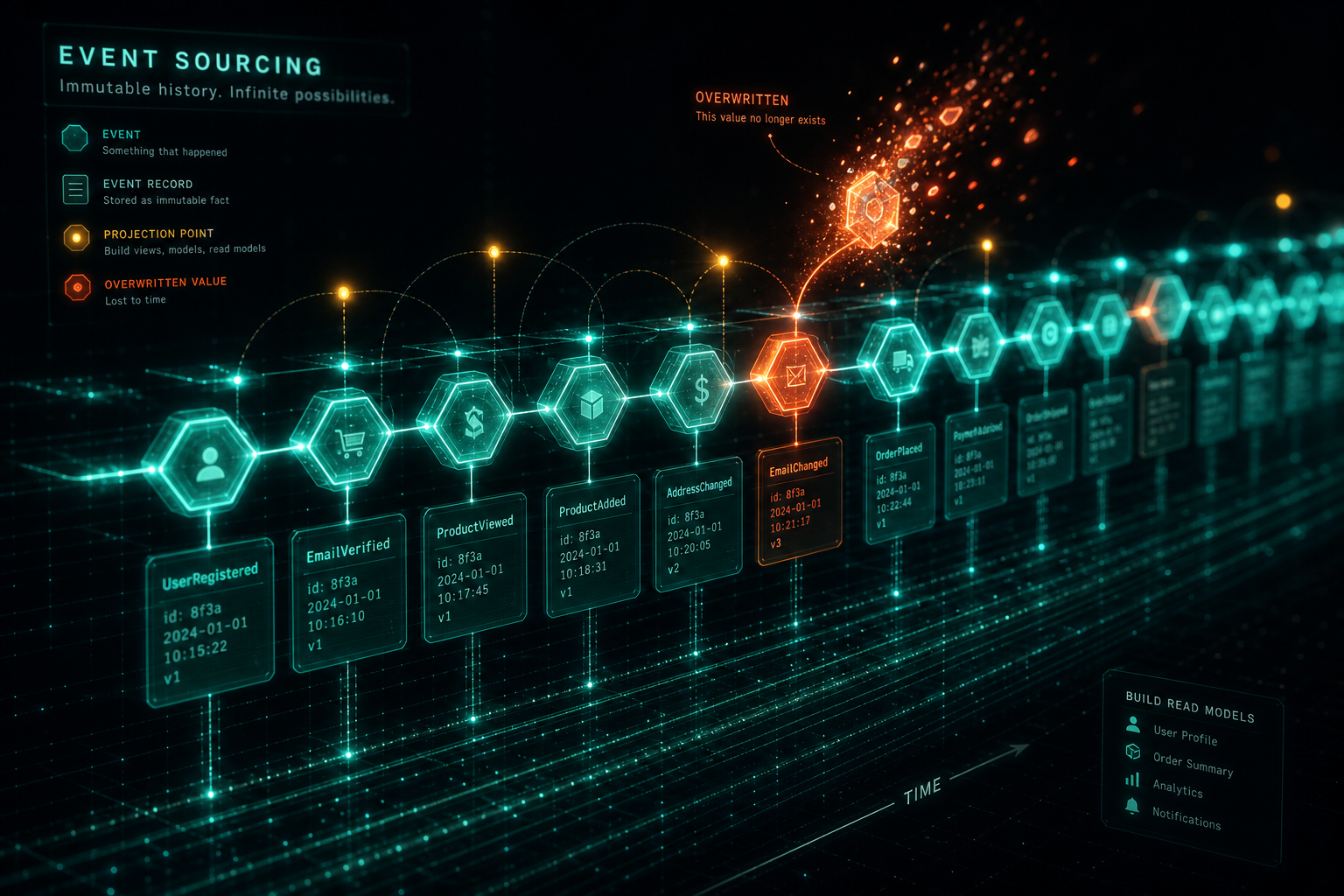
A story-driven, challenge-based course for developers and architects. You join Relay, a parcel and payments startup running on a system that overwrites its own history, and you rewire your default from CRUD to event sourcing, while learning the few cases where it is the wrong tool. You make the calls, you hit the consequences of the wrong ones, and you advance only by explaining your reasoning.
Expect to be stretched past what is spelled out. The course questions you toward each answer instead of handing it over, and you move forward only by explaining the why.
Expect to be stretched past what is spelled out. The course questions you toward each answer instead of handing it over, and you move forward only by explaining the why.
Key takeaway
Make event sourcing the default you reach for, and know the few times it is not.
Throughout this course you will discover:
- The cost of CRUD: See exactly what a single write overwrites, and why a business that tracks things cannot rebuild the history it threw away.
- Facts, not state: Tell a command from an event, name events as past-tense facts, and validate before you append the one you cannot take back.
- Two doors: Split the write side from the read side, build read-model projections, and rebuild them with zero downtime.
- The architect's call: Decide event sourcing, streaming, or CRUD per feature, and separate internal domain events from the integration events you expose.
- Production realities: Work hands-on through eventual consistency, snapshots, schema versioning, idempotency, and GDPR erasure in six interactive simulators.
- Launch night: Defend the whole architecture under pressure in a Final Boss challenge that pulls together every call you have made.
- A field kit you keep: Leave with a decision tool, an event-name linter, and an objection deck for the conversations you will have at work.